Auto-Mode is Now Default: Why Your Engineering Bottleneck Just Shifted from Writing to Reviewing
Insights · 10 August 2026 · 8 min read
Auto-Mode is Now Default: Why Your Engineering Bottleneck Just Shifted from Writing to Reviewing
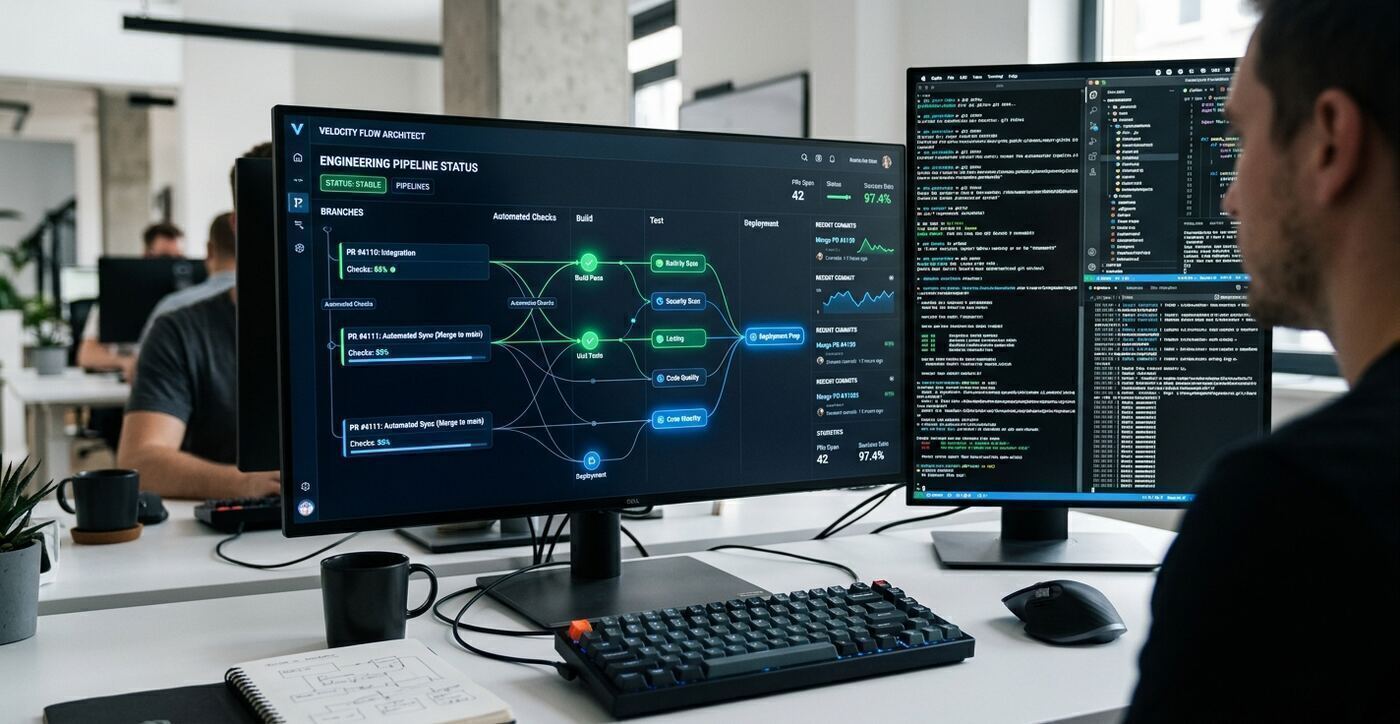
As AI developer tools transition from passive autocomplete copilots to active, autonomous agents, the core bottleneck in software engineering is shifting. CTOs must move their teams away from manual code review toward automated verification architectures. Without programmatic guardrails, adversarial AI reviews, and architectural fitness functions, engineering teams will face severe review fatigue, architectural drift, and security vulnerabilities.
Key takeaways
- The engineering bottleneck has shifted from code generation to code verification due to the rise of autonomous agent execution modes.
- Human reviewers suffer from cognitive fatigue and 'rubber-stamp' machine-generated code, introducing subtle architectural and security risks.
- Traditional CI/CD pipelines are insufficient because they test for known-knowns rather than systemic architectural violations or performance regressions.
- High-performing teams mitigate these risks using adversarial AI-to-AI verification, programmatic architectural fitness functions, and strict Micro-PR policies.
Auto-Mode is Now Default: Why Your Engineering Bottleneck Just Shifted from Writing to Reviewing
A developer on your team sits down, executes a single command in their terminal, and watches an AI agent autonomously spin up a local workspace, run a suite of integration tests, diagnose a broken API contract, modify four files across three directories, re-run the tests to confirm the fix, and submit a comprehensive pull request. This is no longer a speculative demo or a fragile proof of concept. With major AI providers turning autonomous execution modes on by default in developer interfaces—such as Anthropic’s recent decision to enable auto mode by default in Claude Code—this is the new baseline for engineering velocity.
Yet, as software leaders, we must confront an uncomfortable truth: the bottleneck in modern software engineering has officially shifted from code generation to code verification.
For decades, the primary constraint on shipping SaaS products was the speed at which human fingers could translate architectural intent into syntax. Copilots and autocomplete tools accelerated this process, but they still operated on a line-by-line, interactive basis. Autonomous agents operate on a different plane. By executing multi-step planning loops, reading and writing to the local filesystem, and self-correcting based on terminal output, they can generate hundreds of lines of complex changes in seconds.
The result is an impending deluge of machine-generated code that threatens to overwhelm human code review pipelines. If we do not fundamentally change how we validate, test, and govern these changes, our engineering teams will succumb to review fatigue, architectural drift, and silent regression loops.
---
The Illusion of Productivity and the "Rubber-Stamp" Trap
When an agent can generate a 500-line pull request in under a minute, the traditional human code review process breaks down. In cognitive psychology, it is well-established that humans are poorly suited for passive monitoring tasks. When forced to review large volumes of highly coherent, syntactically perfect machine-generated code, human reviewers quickly experience cognitive fatigue.
This leads directly to the "rubber-stamp" trap. Because the code looks elegant and compiles without errors, the human reviewer assumes it is correct and clicks "Approve."
However, syntactical correctness does not equal semantic alignment. In their foundational research on AI as teammates, collaboration scientists in Machines as teammates: A research agenda on AI in team collaboration highlight that treating AI as an active teammate requires a complete redesign of collaborative workflows. If an AI teammate operates at ten times the velocity of its human peers, the collaboration dynamic becomes highly asymmetric. The human is relegated to a quality-assurance bottleneck, constantly playing catch-up.
This asymmetry introduces significant risks. The academic community has already raised concerns about the broader implications of this shift. In the opinion paper “So what if ChatGPT wrote it?” Multidisciplinary perspectives on generative AI, researchers point out that while generative tools democratise creation, they also obscure accountability and ownership. When an autonomous agent refactors a billing module to fix a minor bug, but inadvertently introduces a race condition that only manifests under high concurrent loads, who owns that failure? The developer who ran the command? The author of the agent? Or the team that approved the PR?
---
The Rise of Architectural Drift and "ThreatGPT"
In a B2B SaaS environment, codebases are not just collections of isolated functions; they are complex, living ecosystems with implicit design patterns, performance boundaries, and security constraints. Autonomous agents are highly effective at local optimisation—solving the specific bug or ticket they have been assigned—but they lack context on global architectural cohesion.
Left unchecked, a team of agents operating in "auto mode" will introduce architectural drift. One agent might solve a data-fetching problem by introducing a new state-management pattern in one microservice, while another agent solves a similar problem using a different pattern in another service. Over six months, your clean, modular SaaS architecture degrades into a fragmented, unmaintainable patchwork of competing paradigms.
Furthermore, we must address the security implications of autonomous code generation. In From ChatGPT to ThreatGPT: Impact of Generative AI in Cybersecurity and Privacy, researchers document how generative models can subtly introduce security vulnerabilities, ranging from classic SQL injections to highly sophisticated library-dependency confusion attacks (where an agent hallucinates a non-existent package name, which an attacker then registers on a public registry).
When agents write code autonomously, they do not just write logic; they write infrastructure configurations, database migrations, and IAM policies. A single misconfigured security group or an overly permissive IAM role generated by an autonomous agent can expose sensitive tenant data in a multi-tenant cloud environment.
---
The Counterargument: "But Our CI/CD Pipeline Will Catch It"
The most common counterargument from engineering leaders is that robust CI/CD pipelines and high test coverage mitigate these risks. The argument goes: if the agent’s code passes our unit, integration, and end-to-end tests, we should not care how it was written or how quickly it was generated.
This is a dangerous oversimplification. Traditional test suites are designed to validate known-knowns. They assert that specific inputs yield specific outputs. However, they are remarkably poor at catching:
- Performance regressions: An agent might write a database query that passes unit tests with a mock dataset but causes an N+1 query disaster when executed against a production database with millions of records.
- Architectural violations: Tests do not fail when a developer (or an agent) bypasses an abstraction layer to directly query a database from a presentation component.
- Dead code and bloat: Agents do not care about long-term maintenance costs. They will happily duplicate utility functions across different modules if it helps them solve their immediate task faster.
Relying solely on traditional CI/CD to police autonomous agents is like relying on a smoke detector to prevent arson. It tells you when the house is on fire, but it does nothing to prevent the dangerous behaviour that caused it.
---
How High-Performing Teams Manage the Cognitive Load
To thrive in the era of auto-mode engineering, CTOs must transition their teams from manual code reviewers to automated verification architects. High-performing engineering organisations are adapting their platforms and processes in four concrete ways:
1. Implementing "Adversarial" AI-to-AI Verification
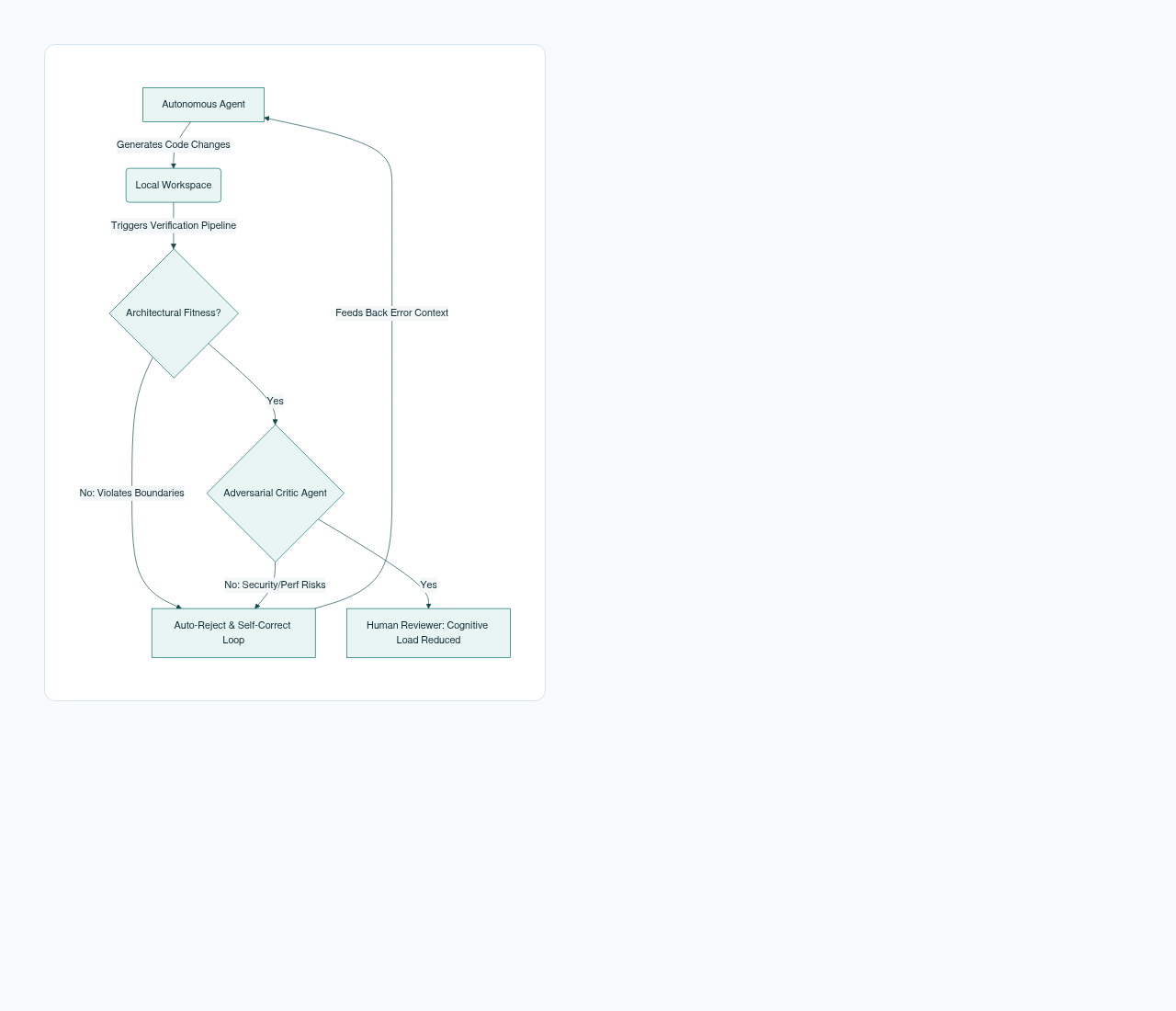
If an AI agent is generating the code, use a different, highly constrained LLM agent to review it before it ever reaches a human. At CST Web Tools, we are experimenting with a dual-agent pipeline: an "Author Agent" writes the feature code, while a separate "Critic Agent"—configured with strict system prompts focused on security, performance, and architectural guidelines—performs a static and semantic analysis of the diff. The PR is only promoted to human review once the Critic Agent gives it a clean bill of health.
2. Programmatic Architectural Fitness Functions
We must codify our architectural boundaries. Using tools like ArchUnit (for JVM languages) or dependency-cruiser (for JavaScript/TypeScript), teams can write automated tests that assert architectural rules. For example, you can write a fitness function that asserts: "No service in the billing domain may import modules from the marketing domain." If an autonomous agent attempts to break this boundary to solve a ticket, the build fails automatically.
3. Micro-PR Policies and Blast-Radius Control
The larger the pull request, the less likely a human is to catch critical flaws. We must enforce strict limits on the scope of autonomous agent runs. Agents should be constrained to "Micro-PRs"—changes that touch fewer than 100 lines of code or target a single, highly isolated component. By minimizing the blast radius of any single agent execution, we make human verification manageable.
4. Semantic Diffing and Intent Verification
Traditional diff tools show you what changed (lines added or deleted), but they do not tell you why. High-performing teams are adopting semantic diffing tools that summarise the intent and impact of the agent’s changes. Instead of reading through 300 lines of refactored code, a human reviewer reads a high-level semantic summary: "This change replaces the custom caching logic in the user service with the standard Redis client, reducing memory footprint by an estimated 12%."
---
The Path Forward: From Code Writers to System Curators
The shift from interactive copilots to autonomous agents is not just a change in tooling; it is a fundamental shift in the identity of the software engineer. In this new paradigm, engineers are no longer bricklayers; they are building inspectors. They are curators of system design, guardians of security, and architects of verification pipelines.
As CTOs, our job is not to slow down the adoption of these autonomous tools. The productivity gains are too immense to ignore. Our job is to build the intellectual and technical infrastructure that allows our teams to leverage this velocity safely. We must invest heavily in developer platform engineering, establish automated guardrails, and train our engineers in the art of rigorous, systemic validation.
The teams that win in the next decade will not be those whose agents write code the fastest. They will be those whose humans can verify it the most reliably.
---
Discussion Question for Your Next Engineering Leadership Sync:
If we enabled autonomous agents to commit directly to our staging environment today, which parts of our verification pipeline would break first, and what does that tell us about our current reliance on manual human QA?
Sources
- Anthropic is turning Claude Code’s auto mode on by default
- Machines as teammates: A research agenda on AI in team collaboration
- Opinion Paper: “So what if ChatGPT wrote it?” Multidisciplinary perspectives on generative conversational AI
- From ChatGPT to ThreatGPT: Impact of Generative AI in Cybersecurity and Privacy