Stop Chasing Full Autonomy: Why the Winning B2B SaaS AI Strategy Is Friction-by-Design
Insights · 2 November 2026 · 7 min read
Stop Chasing Full Autonomy: Why the Winning B2B SaaS AI Strategy Is Friction-by-Design
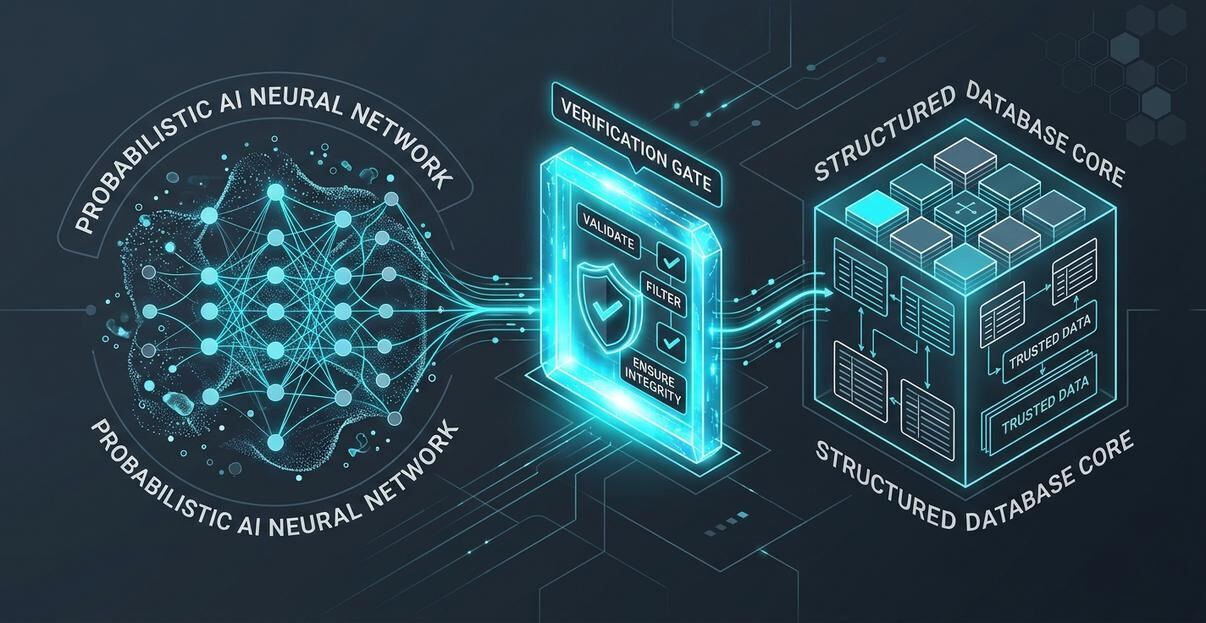
While consumer AI news highlights fully autonomous agents, enterprise software buyers are demanding governance, safety, and operational control. This article explains why CTOs must architect SaaS workflows around friction-by-design, treating probabilistic model outputs as untrusted inputs and building low-friction human validation UX.
Key takeaways
- Treat model outputs as untrusted inputs by separating AI proposal generation from deterministic API execution.
- Implement friction-by-design to replace manual labor with low-friction human verification gates such as structural diffs and inline micro-interactions.
- Maintain robust auditability and attribution by capturing model lineage alongside human user sign-offs.
- Differentiate constructive friction from wasteful friction to maintain product velocity while eliminating enterprise operational risks.
Stop Chasing Full Autonomy: Why the Winning B2B SaaS AI Strategy Is Friction-by-Design
The enterprise software market is currently experiencing a profound hangover. Over the past two years, buyers were promised autonomous artificial intelligence agents capable of running complex business operations without intervention. Software vendors competed in a furious feature race, attempting to demonstrate how their probabilistic systems could eliminate human labor across software development, financial reconciliation, and data infrastructure management.
Yet inside enterprise security reviews and procurement committees, the conversation has fundamentally changed. The initial fascination with generative capabilities has given way to cold operational risk assessments. As Apple Chief Executive Tim Cook noted when addressing their disciplined roll-out strategy, enterprise customers simply do not want vendors to ship AI for AI's sake. Instead, enterprise buyers are asking hard questions: When this model hallucinates, what breaks? Who is legally accountable? How do we stop an autonomous system from altering downstream state without human sign-off?
For Chief Technology Officers, the path forward requires abandoning the fantasy of total agent autonomy. The winning strategy in modern B2B SaaS is not removing the human from the loop; it is designing superior, explicit human verification loops into the core application architecture. We must build applications around a philosophy of friction-by-design.
---
Model Outputs Are Untrusted Inputs
In classical web application security, the fundamental rule is simple: never trust user input. Every string, parameter, and payload originating from a client browser is treated as potentially hostile until validated, sanitized, and type-checked against a strict schema.
When building applied AI capabilities into cloud software, modern software architects must apply this exact principle in reverse. Model outputs are untrusted inputs to your system. Because large language models (LLMs) and foundational architectures are inherently non-deterministic, their outputs represent probabilistic suggestions rather than validated system operations.
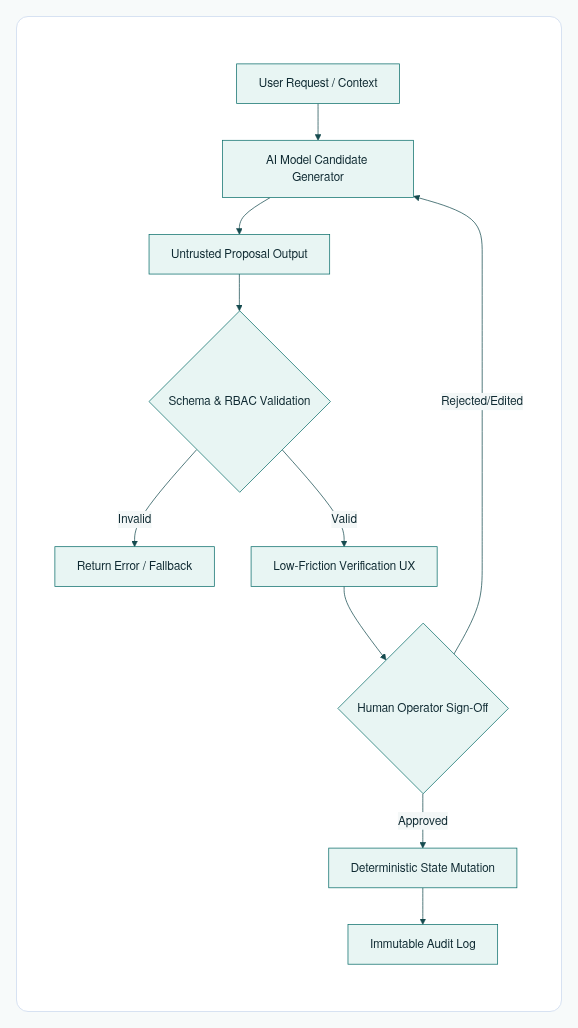
Treating LLM outputs as raw API instructions to be executed directly against your database or infrastructure is an architectural failure. When an AI coding assistant proposes a schema migration or an infrastructure modification, executing that proposal automatically creates unquantifiable operational risk.
As detailed in research on Identity-aware Governance for Autonomous AI Agents, modern enterprise software requires explicit authorization, delegation, and auditing frameworks. An autonomous model cannot hold legal or operational accountability; therefore, its execution scope must be programmatically constrained, and high-impact operations must pass through an explicit human identity verification boundary.
By decoupling model generation from state mutation, product teams can treat model outputs as candidate proposals. The system validates the output structure, checks permissions against the acting user's RBAC matrix, and presents the proposal to a human operator for explicit confirmation before any downstream database state is altered.
---
Engineering Low-Friction Verification UX
If human verification is an architectural requirement, product teams must ensure that adding validation gates does not destroy the software's speed advantage. If reviewing an AI proposal takes longer than performing the manual task from scratch, your product will fail.
Designing low-friction verification UX requires moving away from generic chat interfaces toward domain-specific, contextual review patterns. Consider how high-performing cloud platforms present automated changes:
- Diff-First Interfaces: Instead of outputting free-form conversational text, the software presents structural diffs—highlighting additions in green, deletions in red, and unchanged contexts in grey. The user is not reading a response; they are reviewing an atomic pull request.
- Confidence-Driven Escalation: Low-risk, reversible actions (such as tagging a support ticket or categorising a log entry) can execute automatically if model confidence breaches a high threshold. High-risk actions (such as dropping a database column, updating billing rules, or deploying code to production) should always require explicit human approval, regardless of model confidence.
- Inline Micro-Interactions: Instead of forcing users into complex modal workflows, embed verification directly into the user’s primary workspace. Single-click acceptances, keyboard shortcuts for rapid review, and inline text editing reduce validation friction to milliseconds.
This approach mirrors lessons learned from critical domain integrations. A study on Engineering AI Agents for Clinical Workflows highlights that moving from brittle prototype architectures to governable systems requires designing workflows that preserve human agency while reducing cognitive load. The goal is not to replace human judgment, but to augment it with pre-structured, easily verifiable evidence.
---
Audit Trails, Lineage, and Enterprise Trust
In B2B SaaS, trust is a commercial multiplier. Enterprise buyers choose vendors who can demonstrate how data flows through their platform, who altered what state, and why a specific decision was reached.
When an AI agent operates autonomously in the background, it creates an audit black hole. If a automated workflow mistakenly cancels a enterprise subscription or alters a data pipeline, post-mortem analysis becomes nearly impossible without structured governance.
Architecting for trust requires logging model context alongside human intervention:
- Model Lineage: Record the prompt version, model identifiers, temperature settings, and retrieved context (RAG vectors) that produced the candidate proposal.
- Attribution Mapping: Record the exact identity of the human operator who reviewed, modified, or approved the proposal.
- Governance Compliance: Ensure that open-source model components, dependencies, and fine-tuning datasets comply with software supply chain security rules.
Research regarding Open Source Governance for AI Coding Agents emphasizes that managing model weights, training data, and derivative works is becoming as critical as traditional open-source licence management. Enterprise buyers will reject SaaS platforms that cannot guarantee complete transparency regarding how AI models were trained, hosted, and controlled.
---
Counterargument: Does Friction Impair Product Velocity?
Advocates of fully autonomous AI agents argue that introducing mandatory human verification gates severely limits system throughput. They contend that requiring a human to review every action reintroduces the exact bottleneck that AI was designed to eliminate.
This argument misses a crucial distinction between wasteful friction and constructive friction.
Wasteful friction is forcing a human user to perform repetitive, low-value manual steps—such as copying data between three different SaaS dashboards or writing boilerplate infrastructure code from scratch. Constructive friction is presenting a synthesized, fully drafted proposal to a qualified engineer and asking for a two-second verification click.
When you replace manual synthesis with automated candidate generation, your users still experience an order-of-magnitude increase in operational velocity. However, by retaining the constructive friction of explicit verification, you eliminate catastrophic tail risks. Enterprise customers are more than willing to trade a 5% drop in theoretical top-speed autonomy for a 100% guarantee against uncoordinated production failures.
---
What High-Performing SaaS Teams Do Differently
Engineers and product leaders who successfully ship production-grade AI features inside enterprise SaaS applications share a set of common architectural practices:
- They separate context retrieval from execution. They use AI models to gather data, synthesize information, and construct execution plans—but they use deterministic, well-tested API clients to perform the actual state changes after validation.
- They standardise on verification schemas. They do not allow models to emit unstructured text when action is required. They enforce JSON Schema or Protocol Buffer outputs, validating that the model's output conforms strictly to expected parameters before rendering it to the user.
- They design for progressive autonomy. Systems start by requiring human validation for 100% of actions. As telemetry proves high accuracy for specific low-impact sub-tasks, the application selectively offers automated policies that users can opt into on a granular basis.
- They view the human operator as a supervisor, not a bottleneck. The UX is designed to keep the user in a state of high situational awareness, giving them the exact context needed to approve or adjust AI proposals instantaneously.
---
The Strategic Advantage of Controlled AI
The race for total AI autonomy in enterprise software has hit the reality of operational accountability. Enterprise buyers are no longer impressed by demo videos showing agents operating without guardrails. They are actively seeking software providers who understand enterprise risk, governance, and system reliability.
By architecting your SaaS platform around explicit human verification loops, treating model outputs as untrusted payload, and building intuitive review workflows, you deliver the real promise of applied AI: multiplying human capability without compromising system integrity.
How is your engineering organisation balancing automated AI action with explicit user verification gates? Are your customers asking for autonomous agents, or are they demanding better control mechanics?
Sources
- Apple CEO says the company doesn’t ‘want to ship AI for AI’s sake’
- Identity-aware Governance for Autonomous AI Agents: A Framework for Enterprise Authorization, Delegation, and Audit
- Engineering AI Agents for Clinical Workflows: A Case Study in Architecture, MLOps, and Governance
- Open Source Governance for AI Coding Agents