The B2B SaaS AI Graveyard: Why CTOs Must Prune Speculative GenAI Features to Save Their Product Roadmaps
Insights · 16 November 2026 · 7 min read
The B2B SaaS AI Graveyard: Why CTOs Must Prune Speculative GenAI Features to Save Their Product Roadmaps
This thought-leadership article addresses the urgent need for SaaS CTOs to audit and deprecate non-performing generative AI features. It details how shallow AI wrappers introduce architectural technical debt, degrade unit economics, and clutter user interfaces. The essay presents a practical framework for sunsetting low-value features and reallocating engineering bandwidth toward high-retention, workflow-native automations.
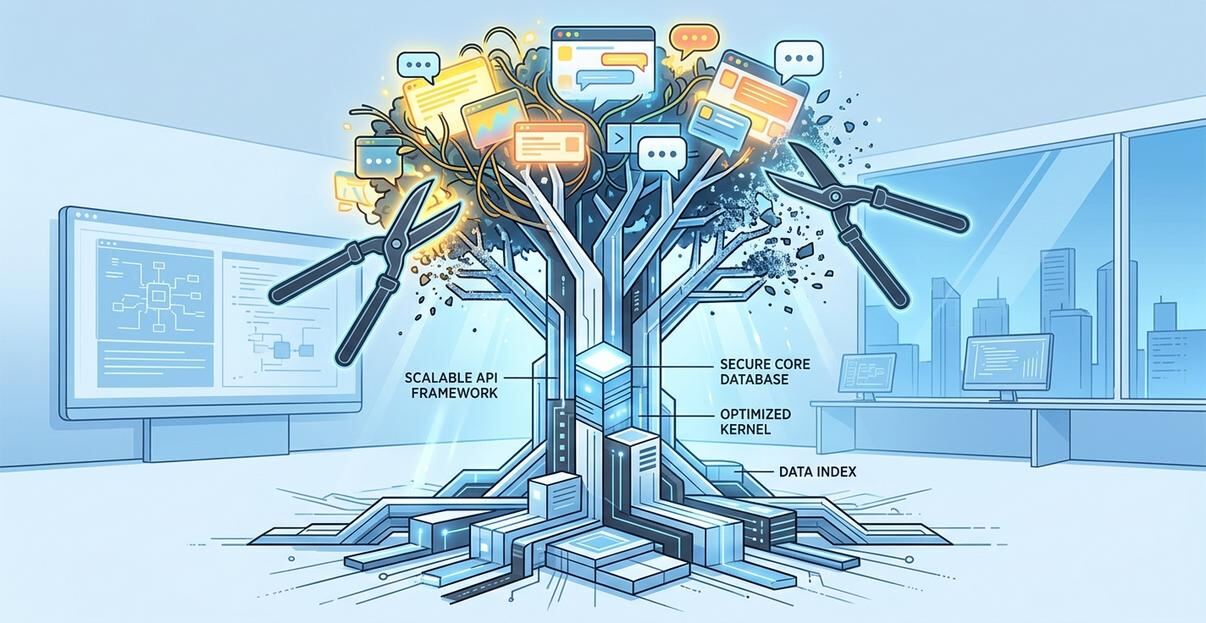
Key takeaways
- Production telemetry shows low adoption (sub-5% DAU) and high churn for generic GenAI side-drawers and chat wrappers.
- Non-linear API costs and dynamic prompt orchestration degrade SaaS gross margins without driving long-term enterprise retention.
- Shallow AI wrappers add visual clutter and state synchronization issues, degrading core workflow usability.
- High-performing engineering teams actively prune speculative AI features to focus resources on workflow-native, background intelligence.
The B2B SaaS AI Graveyard: Why CTOs Must Prune Speculative GenAI Features to Save Their Product Roadmaps
Over the past twenty-four months, enterprise software roadmaps succumbed to a collective imperative: attach generative AI to every existing screen. Product managers rushed floating chat drawers into production, engineering teams wrapped public Large Language Model (LLM) endpoints in thin orchestration layers, and marketing leaders broadcasted "AI-powered" rebrands.
Today, production telemetry presents a sober audit of that era. Across B2B SaaS platforms, the metrics for these speculative features are dismal. Initial usage spikes driven by novelty have given way to sub-5% daily active adoption, high thirty-day churn, and bloated user interfaces that obscure core workflows. Meanwhile, infrastructure teams are left managing unpredictable API billing schedules, non-deterministic latency spikes, and severe technical debt.
As noted in recent industry tracking of failing projects in The AI Graveyard, the market is ruthlessly filtering out shallow AI implementations. For Chief Technology Officers, the directive is clear: it is time to systematically prune non-performing GenAI feature wrappers to restore engineering velocity, protect SaaS unit economics, and focus on workflow-native value.
The High Cost of the "AI Drawer" Architecture
The primary error of the first GenAI wave was structural. Rather than reimagining how users interact with complex data, software organisations bolted conversational interfaces onto existing user interfaces. A cloud management platform, for example, added a side drawer to help users "ask questions" about their infrastructure cost data, alongside traditional tabular displays.
As research published in Reimagining Enterprise SaaS Products with AI highlights, enterprise software features bolted onto legacy screens consistently generate a predictable pattern: an initial press-driven spike followed by a quiet, irreversible plateau in adoption. Users do not open a B2B SaaS application to chat; they open it to execute a specific operational workflow. Forcing users to translate natural language into structured queries through a floating prompt box introduces cognitive friction rather than eliminating it.
Beyond poor user experience, these wrappers extract a heavy architectural tax. Every non-performing LLM integration requires:
- Context-Window Maintenance: Continual plumbing to feed dynamic database schema or application state into prompt templates.
- Deterministic Fallbacks: Guardrails and error handlers when the underlying model hallucinates schema keys or fails to parse JSON responses.
- Egress and API Overhead: Persistent cloud egress costs and third-party model inference fees that erode gross margins on low-tier subscriptions.
- Maintenance Burden: Constant refactoring required by upstream model version deprecations and breaking SDK updates, a challenge thoroughly documented in Neural Transition-based Parsing of Library Deprecations.
When an AI feature yields a 3% daily active user rate but demands 15% of your platform team's sprint capacity to maintain prompt stability and handle model updates, it is no longer an innovation experiment. It is toxified technical debt.
Unit Economics: Protecting Gross Margins in the Cloud
In traditional SaaS architecture, variable cost per user scales predictably with compute, storage, and database read/write cycles. Integrating third-party LLM APIs introduces a non-linear variable cost structure.
Consider a data analytics platform offering an AI-assisted SQL generator. If five percent of power users execute complex prompts that process large schema payloads across multiple context iterations, the underlying inference costs can quietly destroy the margin profile of those enterprise contracts. If that SQL generator frequently generates syntactically invalid queries—requiring secondary correction calls—the cost per successful task doubles.
Engineering leaders must evaluate AI features through the strict lens of cost-to-serve versus demonstrated customer retention. If a feature fails to drive measurable retention, upsell conversion, or task completion efficiency, its ongoing compute and maintenance footprint cannot be justified. Pruning these features directly restores gross margin health, freeing infrastructure budget for core platform optimisations.
The Cognitive Friction of Unstable State and UI Bloat
When features are rushed to market, user interfaces become cluttered with redundant entry points: "Summarise with AI" buttons atop data tables, contextual tooltips that offer unwanted suggestions, and omnipresent sparkle icons that dilute visual hierarchy.
Moreover, managing state across generative interfaces presents severe engineering hurdles. As explored in research on Presentation, Not Mechanism: A Render Confound in Deprecation-Aware Memory Evaluation, AI systems frequently struggle to maintain consistent context when underlying application state changes or when dynamic records revise themselves over long user sessions. When an AI feature presents stale, superseded, or contradictory context to a user inside a business-critical SaaS platform, user trust collapses entirely.
Restoring UI hygiene requires stripping away superficial overlays. High-value software platforms do not distract users with generic conversational agents; they provide concise, contextually aware tools that solve explicit problems within the primary canvas.
Commercial Counterarguments and the Executive Trade-Off
Deprecating features—especially those launched with market fanfare—meets resistance. Commercial teams worry about competitive parity during Request for Proposal (RFP) cycles. Sales leaders often express concern that removing an AI badge will make the product appear outdated alongside competitors who still promise "AI for everything".
CTOs must reframe this conversation around core product value and engineering velocity. An enterprise customer standardises on a SaaS platform because it executes complex workflows reliably, securely, and fast. A cluttered product with broken, slow, or trivial AI features harms enterprise sales far more than a clean, highly performant product that delivers targeted, high-precision automation.
To navigate this trade-off effectively:
- Rely on Hard Telemetry: Present clear data showing actual monthly usage versus the maintenance overhead and model cost per active user.
- Differentiate Demo-Ware from Workflow Value: Demonstrate how removing shallow chat wrappers allows the team to reallocate capacity toward background AI automations that deliver real functional power.
- Modernise Core Infrastructure: Shift engineering resources back to fundamental platform enhancements, using intelligent code refactoring tools to accelerate technical debt cleanup as outlined in studies on AI-Powered Strategies for Modernizing Legacy Web Applications.
The Deprecation Framework for Engineering Leaders
Pruning software requires disciplined execution. CTOs should institute a structured evaluation framework across all GenAI implementations currently in production:
1. The Telemetry and Value Audit
Categorise every AI feature across two axes: Usage Frequency (DAU/MAU) and Task Completion Success Rate. Features falling into the low-usage, low-success quadrant must be immediately flagged for deprecation.
2. Behavioral Segmentation
Analyse user cohorts using advanced segmentation models, leveraging principles described in AI-Powered Market Segmentation and Personalization Strategies. Determine whether feature usage is concentrated among a small fraction of trial users testing novelty or tied directly to high-retention enterprise accounts.
3. Graceful Sunset Strategy
Communicate feature sunsets transparently. Provide clear timelines, remove UI entry points systematically, and turn off background polling endpoints to reclaim server resources. Redirect API expenditure directly into core system performance and security.
4. Pivot to Workflow-Native "Silicon Colleagues"
Reinvest reclaimed engineering cycles into applied AI that works quietly behind the scenes. Rather than asking users to prompt a model, build background intelligence into existing actions:
- Automatic schema validation during data imports.
- Background error diagnosis inside log management views.
- Context-aware code completion embedded directly into developer tools.
In this paradigm, AI acts as an invisible, highly capable colleague embedded directly inside the workflow—not a noisy chatbot demanding attention in a side drawer.
Conclusion: Product Maturity Through Pruning
The era of speculative GenAI feature-stuffing in B2B SaaS has reached its end. True technology leadership is defined not by how quickly a team adopts raw API endpoints, but by the discipline with which it curates product architecture and protects engineering focus.
By deprecating shallow AI wrappers, CTOs can eliminate technical clutter, protect SaaS unit economics, and refocus engineering teams on building high-retention, high-value software. Pruning is not an admission of failure; it is the definitive sign of a mature engineering organisation building for long-term sustainability.
***
CTO Discussion Question: Which GenAI features in your current product roadmap have produced real retention improvements, and which have turned out to be expensive UI bloat that should be sunsetted this quarter?
Sources
- The AI graveyard: a running list of projects and startups that didn’t make it
- Reimagining Enterprise SaaS Products with AI: An Architect's Perspective on Infusing AI Use Cases Without Breaking the Product
- Neural Transition-based Parsing of Library Deprecations
- Presentation, Not Mechanism: A Render Confound in Deprecation-Aware Memory Evaluation
- AI-Powered Strategies for Modernizing Legacy Web Applications