Stop Blaming the Customer: Why SaaS CTOs Must Architect Application-Level Tenant Isolation
Insights · 7 August 2026 · 8 min read
Stop Blaming the Customer: Why SaaS CTOs Must Architect Application-Level Tenant Isolation
This article challenges B2B SaaS CTOs to move past the 'shared responsibility' excuse for customer-side credential leaks. By examining recent high-profile data platform breaches, it argues for the urgent implementation of application-level tenant isolation, ephemeral scoped credentials, and row-level database security, while leveraging AI-driven infrastructure auditing to manage complexity.
Key takeaways
- Logical isolation via simple tenant_id filters is insufficient for modern downstream data platforms.
- True security requires Application-Level Tenant Isolation (ALTI) using ephemeral, scoped credentials and envelope encryption.
- Row-Level Security (RLS) should be enforced directly at the database layer to prevent developer errors from leaking tenant data.
- Leveraging AI tools to audit infrastructure-as-code ensures security policies are strictly maintained without slowing down delivery.
Stop Blaming the Customer: Why SaaS CTOs Must Architect Application-Level Tenant Isolation
For years, SaaS vendors have treated the "shared responsibility model" as a get-out-of-jail-free card. When a client’s API token is leaked, or an administrator fails to enforce multi-factor authentication (MFA) on a critical connection, we shrug, point to our terms of service, and blame their poor credential hygiene.
But this defensive posture is no longer viable. The security perimeter of modern B2B SaaS has shifted. We are no longer just managing isolated web applications; we are building deeply integrated, multi-tenant data pipelines that feed downstream analytical platforms, data lakes, and applied AI engines.
The systemic danger of this shift was laid bare by the devastating credential-stuffing attacks targeting Snowflake customers, which led to massive data thefts across more than 165 organisations, as detailed in reports of the hacker's subsequent guilty plea on TechCrunch. While commentators blamed the victims for not enabling MFA, the architectural truth is more uncomfortable: SaaS platforms that allow long-lived, static, single-factor credentials to access consolidated data stores are building on sand.
As CTOs, we must stop treating downstream data platforms as secure black boxes. If a customer's compromised credential can expose their entire historical analytical data set—or worse, allow lateral movement into other tenants' environments—the failure belongs to the software architect, not the end user. We must transition to a zero-trust architecture characterized by application-level tenant isolation, dynamic credential rotation, and cryptographic boundaries.
---
The Illusion of Downstream Security
To understand why our current approach is failing, we must look at how modern enterprise data systems are built. To remain competitive, organisations rely heavily on centralising data lakes and data warehouses to drive business intelligence, as highlighted in academic reviews of modern enterprise data management.
In a typical B2B SaaS setup, data flows from the transactional application database to an analytical data warehouse. To simplify engineering, SaaS platforms often use a shared-database or shared-schema model, relying on a simple tenant_id column to segregate customer data at the application layer.
This design pattern relies on logical isolation. It assumes that as long as our SQL queries contain WHERE tenant_id = ?, the data is safe. However, this assumption falls apart when we expose direct access to downstream platforms via static API keys, BI connectors, or reverse-ETL pipelines.
As noted in early research on cloud computing security issues, outsourcing essential data infrastructure to third parties makes maintaining data integrity and confidentiality inherently harder. When we delegate storage and query execution to third-party data platforms without enforcing strict, runtime-level tenant boundaries, we introduce a massive, unmonitored attack surface. A single leaked credential or SQL injection vulnerability can bypass the logical tenant_id filter entirely, exposing the raw data of every customer on the platform.
---
Architectural Remedy: Application-Level Tenant Isolation (ALTI)
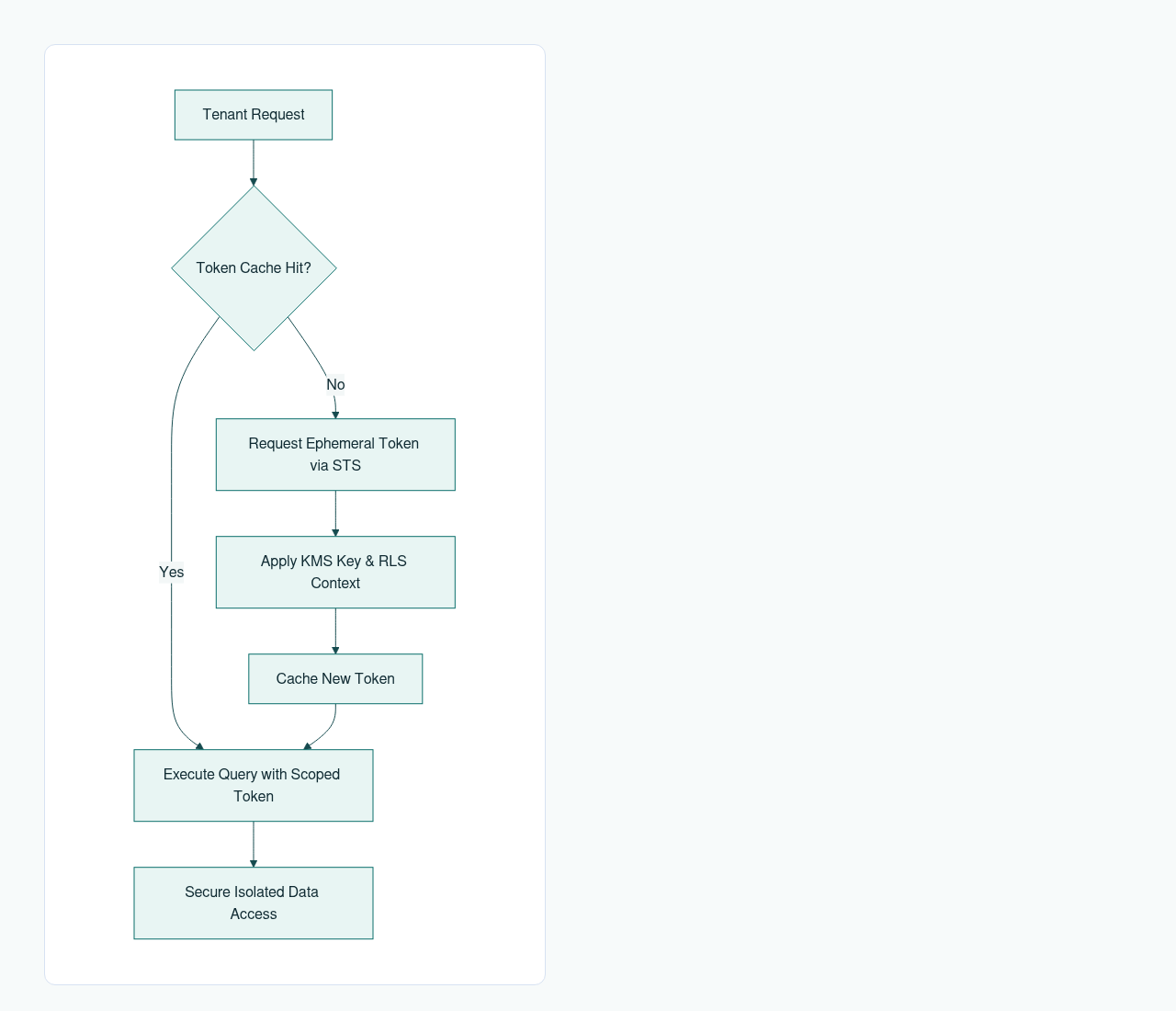
We must move away from shared database credentials and towards Application-Level Tenant Isolation (ALTI). In an ALTI paradigm, the application layer does not connect to the database or data warehouse using a single, highly privileged service account. Instead, every database connection, query, and storage request is executed using an ephemeral, scoped credential tied uniquely to the active tenant’s context.
To implement ALTI effectively, engineering teams should adopt three core architectural principles:
1. Ephemeral, Scoped Credentials
Never hardcode or store long-lived credentials for database or data warehouse access. Instead, leverage cloud-native Identity and Access Management (IAM) token-exchange mechanisms. When a tenant requests data, the application should call a security token service (STS) to generate a short-lived credential (valid for minutes, not days) that is restricted via IAM policy to that specific tenant’s data folder or database schema.
2. Cryptographic Envelope Encryption
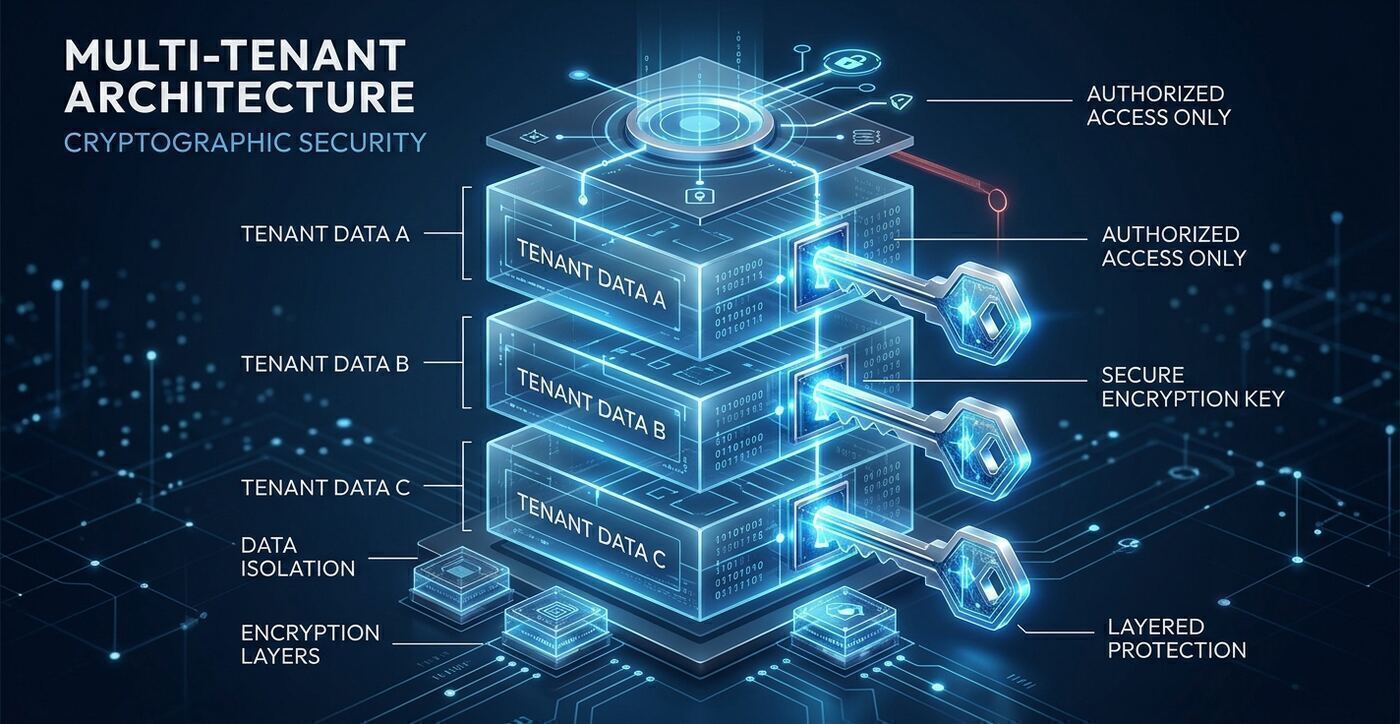
Logical isolation is insufficient when data sits at rest in shared cloud buckets. SaaS platforms should implement envelope encryption, where each tenant’s data is encrypted with a unique Data Encryption Key (DEK). This DEK is, in turn, encrypted by a Key Encryption Key (KEK) managed in a dedicated Key Management Service (KMS) owned by—or delegated to—the specific tenant.
If a malicious actor gains access to the underlying storage bucket or database, the data remains unreadable without the tenant’s KMS key. This also gives enterprise customers a "cryptographic kill switch": if they revoke our access to their KMS key, their data instantly becomes unreadable, guaranteeing absolute deletion.
3. Row-Level Security (RLS) Enforced at the Database Layer
If you must use a shared database, do not rely on your application code to append the correct tenant_id to every query. Force the database engine to do it. Modern relational databases and data warehouses support native Row-Level Security. By setting the tenant context at the start of every connection session (e.g., SET LOCAL app.current_tenant_id = 'tenant_123'), the database itself filters out all other tenants' data, preventing developer error from causing cross-tenant data leaks.
---
Implementing Automated Credential Rotation at Scale
Moving to dynamic, ephemeral credentials introduces significant operational complexity. If your application handles thousands of concurrent tenants, generating and rotating credentials on the fly can quickly become a performance bottleneck.
To solve this, high-performing teams use a hybrid caching and rotation strategy.
Instead of requesting a new IAM token from the cloud provider for every single HTTP request, the application maintains an in-memory, encrypted cache of active tenant tokens. These tokens are requested with a short Time-To-Live (TTL)—typically 15 to 30 minutes. A background worker proactively refreshes tokens that are within 5 minutes of expiry.
If a tenant's session is revoked, or if anomalous activity is detected, the application layer can instantly purge that tenant's active tokens from the cache, immediately severing all downstream database connections for that specific tenant without affecting the rest of the platform.
---
The Human-AI Collaboration Advantage in Security Engineering
Architecting these complex zero-trust pipelines is historically slow and error-prone. However, the rise of applied AI tools—our "silicon colleagues"—has fundamentally changed how engineering teams can implement and maintain these systems.
Rather than relying on human developers to manually draft complex IAM policies, Terraform configurations, and KMS key policies, we can use generative AI models to write, audit, and verify our isolation boundaries.
At CST Web Tools, we use automated AI agents integrated into our CI/CD pipelines to perform static analysis on infrastructure-as-code (IaC) files. The AI model is trained to flag any Terraform block that attempts to create a wildcard (*) resource policy or a database connection pool that lacks dynamic tenant-context initialization. This allows us to ship highly secure, isolated infrastructure at the speed of modern product delivery, ensuring that security is never sacrificed for velocity.
---
The Pragmatic Trade-offs of Zero-Trust Separation
As with any architectural decision, implementing strict application-level tenant isolation involves significant trade-offs.
First, there is a latency penalty. Initiating token exchanges with identity providers or decrypting data via KMS calls adds milliseconds to request round-trips. While caching mitigates this, highly read-intensive, real-time SaaS applications will experience a measurable performance overhead.
Second, operational cost increases. Cloud providers charge per KMS API call and token-generation request. For high-volume platforms, migrating from a single shared database user to millions of dynamic KMS operations can increase cloud infrastructure bills by 15% to 30%.
Finally, debugging becomes significantly harder. When data is cryptographically isolated and access tokens are ephemeral, developers can no longer easily run local queries against production-like datasets to debug customer issues. Engineering teams must invest heavily in building secure, anonymised staging environments and zero-knowledge debugging tools.
Is this added cost and complexity worth it? Absolutely. The cost of a multi-tenant data breach—both in terms of regulatory fines and catastrophic loss of customer trust—dwarfs the incremental cloud spend required to build a resilient, zero-trust data architecture.
---
Actionable Steps for SaaS Engineering Leaders
If you want to move your platform away from the fragile, shared-credential paradigm, start with these three concrete steps:
- Audit your downstream connections: Identify every pipeline, BI tool, and ETL process that connects to your database or data warehouse using a static, password-based service account. Prioritise migrating these to IAM role-based authentication or OAuth-driven federated identity.
- Implement Row-Level Security today: If you are running on PostgreSQL, SQL Server, or a modern data warehouse, enable native Row-Level Security on your multi-tenant tables. It is the single most effective safety net against developer-introduced data leaks.
- Automate policy verification: Integrate security-focused AI models into your pull-request workflow to automatically review and reject any code or infrastructure changes that bypass your tenant isolation layers.
We must stop blaming our customers for security failures when our own architectures make those failures catastrophic. By designing application-level tenant isolation and automated credential rotation directly into our platforms, we protect our customers, secure our data, and build the trust required to lead in the age of shared-data platforms.
---
Discussion Question
How does your engineering team balance the performance overhead of dynamic KMS decryption with the security necessity of cryptographic tenant isolation? Let’s discuss in the comments.