Work With Your Silicon Colleagues — Don’t Just Prompt Them
Insights · 17 August 2026 · 8 min read
Work With Your Silicon Colleagues — Don’t Just Prompt Them
As AI coding assistants integrate into everyday SaaS engineering, simply buying licenses and prompting models is no longer enough. To maintain code quality and prevent technical debt, engineering leaders must treat AI as a 'silicon colleague'—combining rapid machine execution with rigorous human oversight, architectural context, and updated peer-review standards.
Key takeaways
- AI tools are highly productive but lack accountability; humans must remain the ultimate owners and architects of the codebase.
- The 'silicon colleague' framework requires applying the same—or stricter—PR review standards to AI-generated code as human code.
- Generative AI benefits junior developers the most, meaning senior mentorship must shift from teaching syntax to teaching code evaluation and system architecture.
- High-performing teams integrate AI into structured workflows with automated CI/CD guardrails, rather than relying on ad-hoc IDE prompts.
Work With Your Silicon Colleagues — Don’t Just Prompt Them
The romanticised promise of generative AI in software engineering goes something like this: a developer types a elegant, single-sentence prompt into a chat interface, and a fully formed, production-ready microservice materialises. Technical debt vanishes, velocity triples, and the CTO can sit back and watch the feature roadmap deliver itself.
Anyone who has actually managed a multi-tenant cloud platform at 3 AM knows this is a fantasy.
When an incident occurs because an auto-generated database migration locked a critical table in production, the AI model does not jump on the Slack war room. It does not explain its reasoning to the board, nor does it refactor the underlying architectural mismatch that caused the failure.
As SaaS engineering leaders, we are entering a critical phase of technological maturity. The initial novelty of coding assistants has worn off. We have bought the licences, integrated the IDE extensions, and watched our teams marvel at the speed of boilerplate generation. Yet, many engineering organisations are realising that simply throwing AI tools at developers does not automatically translate to shipping better software faster. In fact, without a fundamental shift in how we structure our workflows, it often leads to a deluge of low-quality code, architectural drift, and a subtle erosion of systemic understanding across the team.
To win in the next era of SaaS delivery, we must stop treating AI as a magical oracle to be prompted. Instead, we must treat it as a capable, highly productive, but occasionally erratic "silicon colleague". This requires shifting from ad-hoc prompting to deliberate, human-centric collaboration models.
---
The Illusion of the "10x Prompt"
The historical precedent for this shift is clear. Throughout industrial history, technical innovations have succeeded by transforming manual tasks where humans reached the limits of their physical or cognitive capacity, as explored in early foundational research on Artificial Intelligence perspectives. Today, generative AI represents a similar leap for cognitive labor.
However, the prevailing industry narrative has overemphasised the act of "prompting" as an isolated skill. We are told that "prompt engineering" is the career of the future. This is a misunderstanding of how complex software is built. Innovation, as Tom Freston famously noted, is about taking two things that exist and putting them together in a new way—a concept that lies at the heart of how we must conceptualise Generative AI's creative capacity.
In a modern cloud-native SaaS environment, code does not exist in a vacuum. It must integrate with event-driven architectures, adhere to strict security policies, respect multi-tenant isolation boundaries, and run within tight resource constraints. A simple prompt cannot capture this context.
Consider a practical example: writing an asynchronous event consumer in Node.js to process webhook payloads from a payment gateway like Stripe. If a developer prompts an LLM to write this function, the model will likely output syntactically correct code that parses the payload and updates a database.
But a silicon colleague needs to be held to the same standards as a human peer. Will this generated code:
- Handle idempotency to prevent duplicate processing of the same webhook?
- Implement proper database connection pooling to avoid exhausting resources under peak load?
- Gracefully handle rate limits and transient network failures with exponential backoff?
- Log structured metadata without exposing personally identifiable information (PII)?
If the developer simply copies and pastes the generated output, they have not engineered a solution; they have merely outsourced their critical thinking. The real work of engineering is not typing the code; it is the systemic design, the edge-case analysis, and the verification of assumptions.
---
The "Silicon Colleague" Framework in Practice
To move past the prompting paradigm, we must establish clear operational boundaries for AI tools within our teams. This begins with defining the division of labour. The human engineer remains the architect, the strategist, and the ultimate owner of the code. The AI is the junior associate—exceptionally fast, knowledgeable across an immense breadth of patterns, but lacking context, intuition, and accountability.
This division of labour must be reflected in our peer-review standards. In many organisations, there is a dangerous double standard: human-written code is subjected to rigorous pull request (PR) reviews, while AI-generated code is waved through because "the tool said it works."
This is a recipe for disaster. As discussed in multidisciplinary analyses of generative conversational AI implications, the ease with which these tools generate sophisticated, human-like outputs can easily lull users into a false sense of security, raising significant quality, legal, and ethical challenges.
To combat this, high-performing teams apply the same—if not stricter—review standards to AI-assisted code. At CST Web Tools, we advocate for a simple rule: If you didn't write it line-by-line, you must be able to explain it line-by-line.
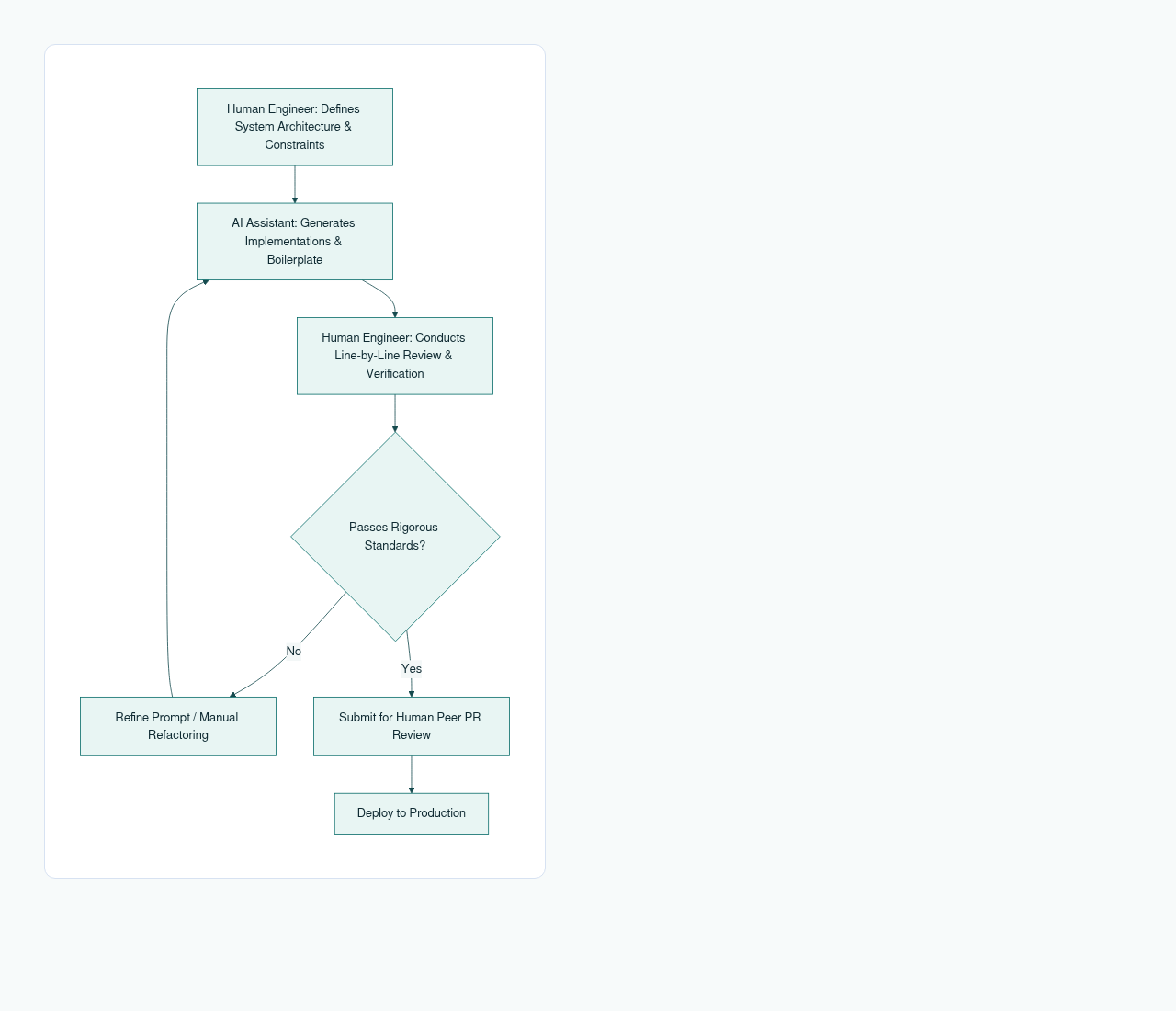
This approach fundamentally changes the developer's role. They transition from a pure writer of code to an editor and a gatekeeper. This shift requires a high level of "AI literacy"—not just knowing how to interact with the models, but deeply understanding their limitations, biases, and failure modes, as outlined in recent frameworks on conceptualising AI literacy.
---
Levelling Up and the Productivity Paradox
There is a well-documented productivity paradox when introducing generative AI to engineering teams. Academic research, such as the landmark study on Generative AI at Work, demonstrates that access to generative tools increases productivity by 14% on average, but the greatest impact is felt by novice and low-skilled workers. For highly skilled professionals, the gains are much more marginal.
In a SaaS engineering context, this means your junior developers will experience a massive boost in velocity. They can now write complex SQL queries, draft unit tests, and navigate unfamiliar frameworks in a fraction of the time.
However, this presents a subtle risk. If junior developers rely on AI to solve every difficult problem, how do they develop the deep debugging skills and mental models required to become seniors? If the AI always provides the answer, the muscle memory of struggling through a complex system is never built.
To mitigate this, senior engineers must pivot their mentorship strategies. Instead of teaching juniors how to write code, they must teach them how to evaluate code. Code reviews should focus less on syntax and style—which can be automated—and more on architectural fit, security implications, and maintainability. We must encourage junior developers to use AI as a sparring partner rather than an autocomplete engine.
---
The Counterargument: Are We Just Adding Friction?
A sceptic might argue that treating AI with this level of caution defeats the purpose of buying the tools in the first place. If we have to review every line of code, run extensive test suites, and cross-examine the AI’s output, do we not lose the velocity gains that justify the subscription costs?
This is a valid concern, but it mistakes localized speed for systemic throughput. Writing code quickly is easy; maintaining code over a five-year lifecycle is hard. The cost of fixing a bug in production is orders of magnitude higher than fixing it during the design or review phase.
Furthermore, the infrastructure supporting these AI tools is becoming highly sophisticated. The market is moving rapidly from simple plugins to robust enterprise gateways, highlighted by major industry movements such as Stripe's reported acquisition of AI gateway startup OpenRouter. This consolidation proves that AI is no longer a collection of rogue desktop tools; it is becoming a core piece of cloud infrastructure that requires governance, monitoring, and structured integration.
By wrapping AI usage in rigorous workflows, we are not slowing down; we are building a stable platform for sustainable velocity. We are ensuring that the code we ship today does not become the legacy nightmare of tomorrow.
---
What High-Performing Teams Do Differently
Teams that successfully integrate silicon colleagues do not just install an IDE extension and hope for the best. They redesign their entire delivery pipeline around collaborative workflows:
- Context-Aware Tooling: They feed their AI tools with rich context—not just the open file in the IDE, but the system architecture diagrams, the API specifications, and the team's internal style guides.
- Automated Guardrails: They implement robust CI/CD pipelines with automated testing, static analysis, and security scanning. These guardrails act as an automated safety net, catching the hallucinated library imports or security vulnerabilities that AI tools occasionally introduce before they reach a human reviewer.
- Prompt Versioning: They treat highly effective system prompts and agent configurations as code. They are version-controlled, reviewed, and shared across the team, ensuring that successful collaboration patterns are institutionalised.
The Path Forward
The future of SaaS engineering is not a choice between human developers and AI agents. It is a synthesis of both.
By treating AI as a silicon colleague, we elevate the role of the human engineer. We move away from the tedious mechanics of syntax and boilerplate, freeing our minds to focus on what truly matters: solving complex business problems, designing resilient architectures, and delivering genuine value to our users.
The next time you open your IDE, do not just ask the AI to write a function for you. Challenge it. Review its work. Ask it to explain its trade-offs. Treat it with the same professional respect—and the same healthy scepticism—that you would show to any other colleague on your team.
---
Discussion Question for the Engineering Community: How has the introduction of AI coding assistants changed your team's pull request review process, and have you had to implement new guidelines to catch "silent" AI errors?
Sources
- Artificial Intelligence (AI): Multidisciplinary perspectives on emerging challenges, opportunities, and agenda for research, practice and policy
- Opinion Paper: “So what if ChatGPT wrote it?” Multidisciplinary perspectives on opportunities, challenges and implications of generative conversational AI for research, practice and policy
- Generative AI at Work
- Generative AI
- Conceptualizing AI literacy: An exploratory review
- Stripe will reportedly acquire AI gateway startup OpenRouter for $7B+